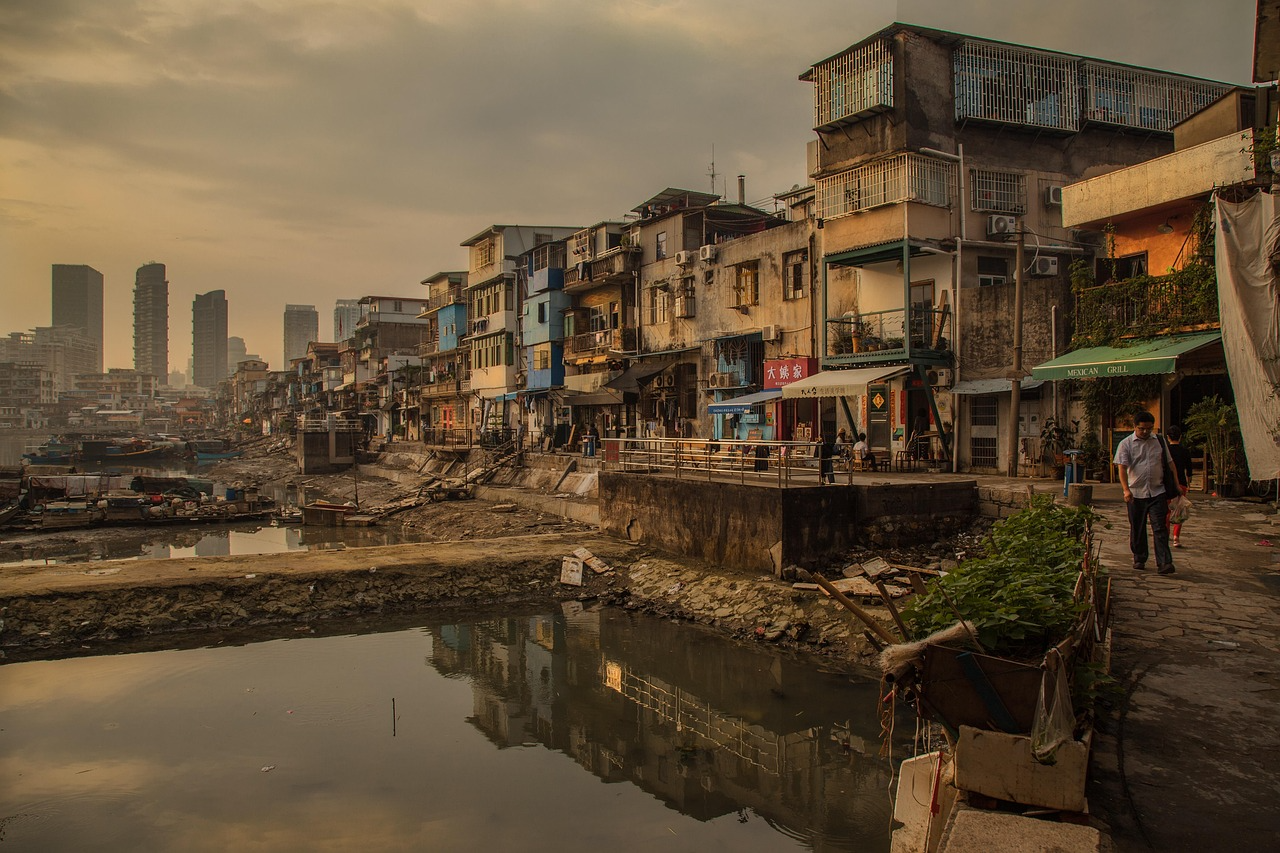
So while watching a vlog of a city travel (I couldn't find the video, I'm sorry, I searched a lot) there was a part where it showed a view from above the city. It showed the wealthier part of it above and below that part the more worn-down looking slum-like part of the city, clearly dividing it into two. And that got me curious...
What are Slums???
So before anything we have to clarify something — the word "slums" is not the same for every country. Some have different words for describing a similar thing but from what I have seen "slums" is the more generally known one for what it represents. Like Favela (Brazil) Gecekondu (Turkey) Bidonville (France/North Africa) Basti (India) — they are not quite the same thing but are quite similar.


(images were from pixabay sorry if they are not really true )
As we can see they differ from each other considering the fact that they are from different countries entirely but we can kinda see the similarities in them. The handcrafted structures, the clumped together architectures, and the worn down looks.
History
Now let's dive into the history of slums, here is what I have found;
While slum-like conditions existed as far back as Ancient Rome in buildings called insulae, the modern slum as we know it today first appeared around 1800 in the industrializing cities of Great Britain.[1]
The Industrial Revolution was the main trigger. In England and Wales alone, the share of people living in cities jumped from 17% in 1801 to 72% by 1891. Cities like Manchester, Liverpool and Birmingham couldn't house the flood of workers fast enough — so slums filled the gap. This pattern then repeated itself across Europe, and later in the United States, where slums exploded in the late 19th century fueled by industrialization and massive waves of immigration.[2] [3]
By the 20th century slum formation was no longer just a European or North American problem. As urbanization spread to Africa, Asia and Latin America, the same pattern repeated — rural people moving to cities looking for work, cities unable to keep up with housing demand, and informal settlements filling the void.[2]
As of 2022, approximately 1.1 billion people live in slums or informal settlements — roughly 1 in 4 urban dwellers on the planet. Around 90% of them are concentrated in Africa and Asia. And it's not slowing down — the UN projects an additional 2 billion people are expected to join that number over the next 30 years.[4] [5]
Long story short, after the Industrial Revolution population started rising rapidly and people couldn't keep up with house prices, so they kinda built their own homes DIY style. Since that problem never really got fully resolved it kept on continuing until today. Hopefully this gets resolved in the near future because everybody deserves a nice warm house and a roof over their heads.